
What is philosophy? Philosophers at the table
In a nutshell
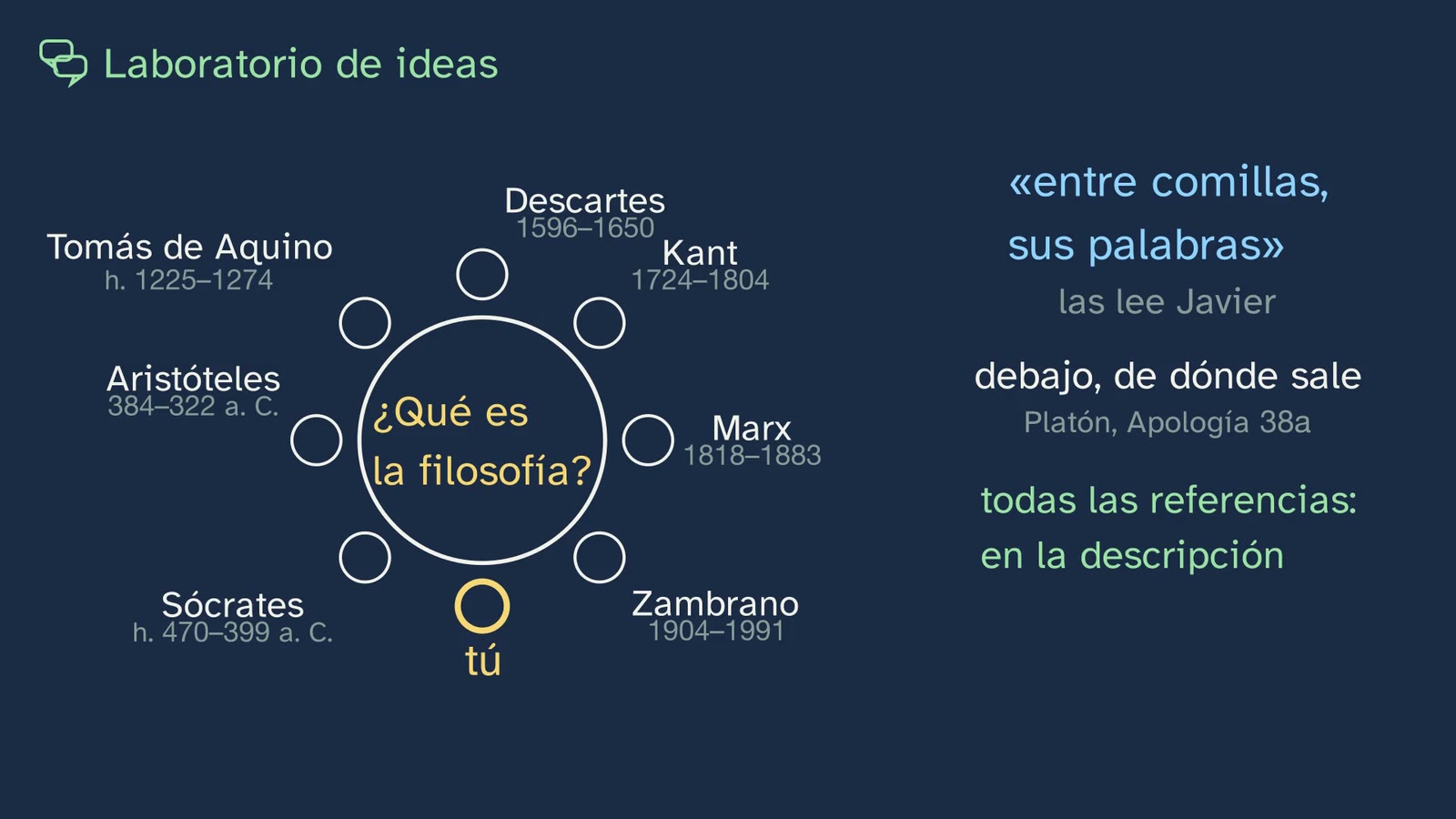
This is the first idea lab of the course: in Philosophy the lab is dialogue, without a lab coat. Seven philosophers from different times sit at an imaginary table and each answers, in their own words, the question in the title: what is philosophy?
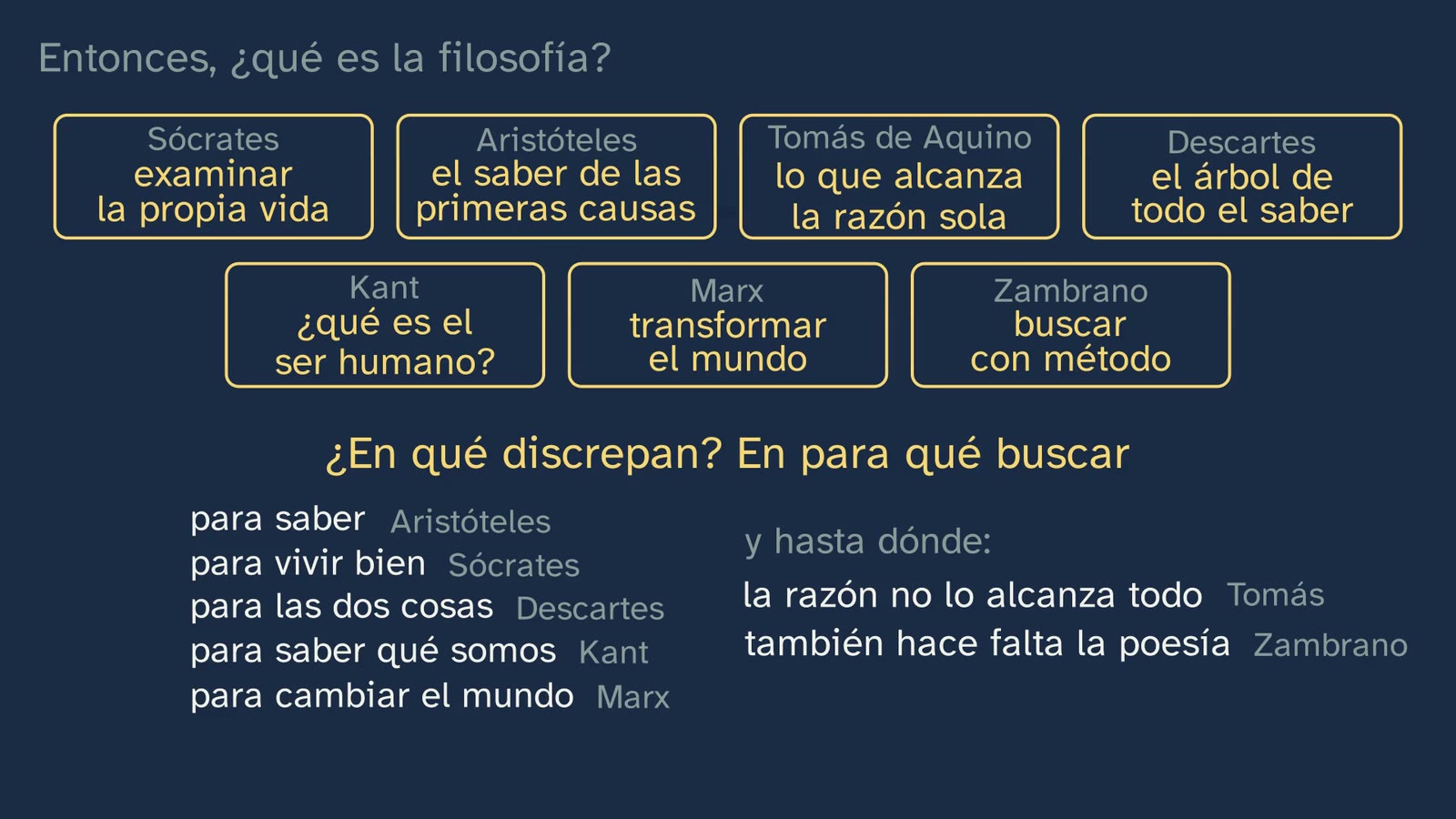
- Socrates: examining your own life.
- Aristotle: seeking the knowledge of first causes, for the sake of knowing.
- Thomas Aquinas: what human reason can reach on its own.
- Descartes: the tree of all knowledge, whose fruit is living well.
- Kant: four questions that lead to one, what is the human being?
- Marx: not stopping at interpreting the world, but helping to change it.
- María Zambrano: a search with a method, which is not everything without poetry.
The class draws out what they share (a search, with reasons, for what lies deepest: the four features from class 1) and where they disagree (what the search is for, and how far it goes). It takes apart the mistake of thinking that, if they don't agree, it's pure opinion. It opens a window outside Europe (Confucius, the Buddha and al-Kindi) and ends with the most important part: each answer at the table becomes a personal question for the student. At the end, the eighth chair is theirs.
Aim. By the end, students will be able to say what philosophy is for seven great philosophers, in their own words, what they have in common, where they disagree, and which convinces them most and why.
Curriculum
Royal Decree 243/2022, Philosophy (consolidated text in the BOE, checked on 03/10/2026). The knowledge is from block A, «Philosophy and the human being», section 1.
| Element | What the decree says | Where it is worked on |
|---|---|---|
| Basic knowledge (block A.1) | «Features and conceptions of philosophical knowledge.» | The seven conceptions, each with its author and quotation; what they share (the four features) and where they disagree |
| Basic knowledge (block A.1) | From the same section: «[…] argumentative thinking and dialogue; […]» | The eighth chair: a position with its reason, an objection and its reply |
| Specific competence 4 | «To practise philosophical dialogue in a rigorous, critical, tolerant and empathetic way […]» | The table, and the structured controversy of the activity |
| Specific competence 5 | «To recognise the plural character of the conceptions, ideas and arguments around each of the fundamental problems of philosophy […] to generate a complex and non-dogmatic conception […]» | What they share and where they disagree; the typical mistake: disagreement doesn't make it pure opinion |
| Specific competence 6 | «To understand the main philosophical ideas and theories of the most important thinkers […] to generate a rigorous and personal conception of what philosophy means […]» | Seven thinkers, and the seven questions for the student |
| Criterion 4.1 | «To promote the contrast and exchange of ideas […] through participation in group activities and the exercise of rational dialogue […]» | The activity |
| Criterion 5.1 | «To generate a complex and non-dogmatic conception of philosophical problems through the critical analysis of different and opposing philosophical theses […]» | The first argument (living or knowing?) and the synthesis |
| Criterion 5.2 | «To understand and present different philosophical theses and theories as moments of a dynamic and always open process of reflection and dialogue […]» | Descartes brings the two Greeks together; Thomas reads Aristotle with Averroes |
| Criterion 6.2 | «To acquire and demonstrate a meaningful knowledge of the philosophical ideas and theories of some of the most important thinkers in history […]» | The seven, with their time and their work |
What students need to bring: class 1 of the topic (the four features, Socrates and the unexamined life, Aristotle and the knowledge that makes nothing, and the difference between having an opinion and defending a position).
How the class is built
Video chapters
About twenty minutes (19:57), in 17 chapters. The decree asks for this subject to be «largely dialogical» and «a real experience of discovery», not an exposition (introduction to the subject). That is why the class doesn't give a definition: it lets seven people give one, draws out what they share, and hands the question back to the student.
| Chapter | What happens | Why |
|---|---|---|
| What we'll see (0:00) | Javier says hello; the topic map, with today's class highlighted. Hook: seven philosophers, one question, and they won't give the same answer. | Knowing where you are, and expecting a disagreement. |
| What you already know (0:26) | The four features from class 1. | Retrieving what the synthesis will use. |
| Solutions to the previous class (0:56) | All four, briefly. | Spaced practice. |
| Seven philosophers at the table (2:17) | The table is imaginary and we say so; Javier reads the quotations; the references are in the description. | Honesty: it is not a simulated debate. |
| Socrates (2:50) | He wrote nothing; the square; the gadfly (Apology 30e); «what I don't know, I don't think I know either» (21d); «an unexamined life is not worth living» (38a). | The father of philosophy, with his own scene. |
| Aristotle (4:16) | «All human beings by nature desire to know» (Metaphysics I 1, 980a21); the knowledge of first causes (982b9–10). The first argument: living or knowing? | Two Greeks, two emphases. |
| Thomas Aquinas (5:25) | Faith and reason: the philosophical disciplines, «which are investigated by human reason» (Summa Theologiae I, q. 1, a. 1); «grace does not destroy nature, but perfects it» (a. 8, ad 2); Averroes, «the Commentator». | The Middle Ages, with its border and its bridge. |
| Descartes' tree (7:07) | Prediction; the tree (preface-letter to the Principles, 1647): roots, trunk, branches and fruit. | An animation you can understand without the voice. |
| Kant's four questions (8:51) | Cosmopolitan philosophy and the four questions (Logic, Ak. IX, 25); stop and think: why do they lead to the fourth? | The map of all philosophy in four lines. |
| Marx (10:13) | Thesis XI, in the 1845 manuscript: the key is «only». | His best argument, without taking sides (article 9 of the channel's Constitution). |
| Zambrano (10:54) | Philosophy and poetry, «two halves of man»: philosophy searches with a method; poetry finds. | A Spanish thinker of the exile. |
| So, what is philosophy? (11:44) | What they share (the four features) and where they disagree (what the search is for, and how far it goes). | The class's answer, presented as its reading (article 10). |
| What if they don't agree? (12:58) | The typical mistake, taken apart: they share what's essential and give reasons; and what philosophy is, like what physics is, is a philosophical question. | The mistake the table itself could cause. |
| Beyond our table (13:41) | Confucius (Analects 2.17), the Buddha (Kalama Sutta, AN 3.65) and al-Kindi (On First Philosophy, section 1). | A window, not a seat: class 3 covers other traditions. |
| Seven questions for you (15:02) | Each answer becomes a personal question, with silence to think. «Choose the one that made you most uncomfortable: that is your question.» | The most important part of the class: philosophy from the inside. |
| The eighth chair (17:17) | The student's position, with a made-up example of reason, objection and reply. Javier doesn't say whom he sits with. | One's own position. |
| Practice and keep thinking (18:12) | Summary, three exercises and the open question. | The solutions open class 3. |
A plan for a 50-minute lesson
| Minutes | What happens |
|---|---|
| 0–3 | No video: each student writes in one sentence what philosophy is (it's on the worksheet). |
| 3–14 | Video from 0:00 to 10:13: from the table to Kant. Stop at the tree prediction (7:10) and at Kant's «stop and think» (9:41). |
| 14–21 | Video from 10:13 to 13:41: Marx, Zambrano, the synthesis and the typical mistake. |
| 21–28 | Video from 13:41 to 17:17: the window and the seven questions. Let each student underline on the worksheet the question that made them most uncomfortable. |
| 28–44 | The activity: structured controversy. |
| 44–50 | Video from 17:17 to the end: the eighth chair. Each student rereads their first sentence and writes their chair. The exercises, for homework. |
Typical mistakes and how they are handled
- «If not even philosophers agree on what philosophy is, it's pure opinion.» This is the class's mistake (12:58). They share what's essential (critical, radical, rational and of the whole) and each gives reasons that can be discussed. And the question of what a field of knowledge is (what physics is, what philosophy is) isn't answered with that field's methods: it is philosophical. Arguing about it is part of philosophy's work; competence 5 of the decree says so: disagreement is «an intrinsic property of philosophical thought».
- «Socrates said: I only know that I know nothing.» As seen in class 1, the phrase isn't in Plato. What his Socrates says is «what I don't know, I don't think I know either» (Apology 21d), and elsewhere he says he does know some things.
- «Thomas knew Aristotle through the Arabs.» He read him in Latin, almost always translated directly from Greek; from Averroes, whom he called «the Commentator», he took the commentaries.
- «Marx said: enough thinking, it's time to act.» The key to thesis XI is «only»: he criticises stopping at interpreting, not thinking.
- «Philosophy is learning what the philosophers said.» With seven names on the board it's worth saying: the class ends by turning each answer into a question for the student. Kant put it this way: you cannot learn philosophy, only learn to philosophise (Critique of Pure Reason, A837–838/B865–866).
Questions and solutions
In the video
- What were the four features of philosophy? (0:26) Critical (it doesn't accept something just because lots of people say it), radical (it goes to the root), rational (it gives reasons) and of the whole (it looks at everything together).
- Prediction: if the whole of philosophy were a tree, what would be in the roots and what fruit would it bear? (7:10) Any reasoned answer is fine. Descartes: roots, metaphysics (first principles); trunk, physics; branches, medicine, mechanics and morals, and the fruit is picked at the ends of the branches, above all in morals.
- Stop and think: why do Kant's first three questions lead to the fourth? (9:41) Because what I can know, what I ought to do and what I may hope depend on what kind of being I am.
- The seven questions (15:02) have no solution: they are for thinking about. In class they can be used for a philosophical journal or to choose one and write a page.
From the student worksheet
- What did Socrates compare himself to, and why? To a gadfly on a large, noble but slow horse that needs waking up (Apology 30e): his role was to wake the city up with questions.
- What does Thomas distinguish at the start of the Summa Theologiae? Two kinds of knowledge: theology, which starts from what God reveals, and the philosophical disciplines, which are investigated by human reason.
- What is in each part of Descartes' tree? Roots: metaphysics; trunk: physics; branches: medicine, mechanics and morals; the fruit, on the branches.
- Which word is the key to Marx's sentence? «Only»: he doesn't say interpreting is useless, but that it isn't enough.
- How do philosophy and poetry differ, for Zambrano? Philosophy searches, with a method; poetry finds, «a finding by grace». They are two halves.
- What do Confucius and Socrates have in common? Both place wisdom in recognising what one doesn't know. They couldn't have met: according to the traditional dates, Confucius died about ten years before Socrates was born.
Practice (the solutions open class 3)
- Choose two at the table who clash: what would one say to the other? Any pair with an argument on each side. Example: Aristotle to Marx, «knowledge is worth it for its own sake, even if it changes nothing»; Marx to Aristotle, «if you only interpret the world, the world stays the same».
- Your eighth chair, in five lines. Look for a clear answer, a reason, an objection from another author at the table and a reply to that objection.
- Ask someone at home what they think philosophy is. Which of the seven is it like? Which feature is missing? Open answer: what counts is justifying the likeness with what each author said and naming the missing feature.
Keep thinking: seven answers in more than twenty centuries: what would the 21st century's be? It has no textbook answer; it links to class 7 of the topic (is philosophy any use in the age of AI?).
A classroom activity: structured controversy
About 16 minutes, in groups of four. Based on Johnson and Johnson's structured controversy: defend a position, switch to the opposite one and reach a synthesis.
- Groups of four, two pairs (1 minute). Choose a tension from the class: is philosophy for living better or for knowing? (Socrates and Aristotle), interpreting or changing? (Aristotle and Marx), is reason enough? (Thomas and Zambrano).
- Prepare (3 minutes). With their author's quotation, each pair writes its best argument, with an example of its own.
- Present (2 + 2 minutes). Each pair presents; before replying, the other pair repeats in its own words the reason it has heard.
- Switch sides (3 minutes). Each pair now defends the opposite position, trying to do it better.
- Synthesis (4 minutes). The four write a sentence they all sign: what each side gets right. If they can't, they write exactly where they disagree.
- Close (1 minute). Each student writes on their worksheet: «For me, philosophy is… because…».
For teachers: as in the video, the teacher moderates and doesn't give a verdict on what is controversial (article 9 of the channel's Constitution). In the tension with Marx, make sure nobody turns it into an argument about today's parties: the question is what philosophy is, in each author's words.
Other answers, to go further
Checked at their source, to widen the table in class:
- Plato: thinking is a dialogue of the soul with itself (Theaetetus 189e–190a).
- Epicurus: nobody is too young or too old to philosophise, because it is about the health of the soul (Letter to Menoeceus 122).
- Hannah Arendt: the need of reason is inspired by the quest for meaning, not for truth (The Life of the Mind, 1978, vol. 1).
- Wittgenstein: philosophy is not a doctrine but an activity that clarifies thoughts (Tractatus, 4.112).
- Ortega y Gasset, Zambrano's teacher: ¿Qué es filosofía? (course of 1929, published in 1957).
Sources
- Royal Decree 243/2022, consolidated text (BOE): https://www.boe.es/buscar/act.php?id=BOE-A-2022-5521.
- Plato, Apology 21d, 30e–31a and 38a (Greek text by Burnet, Perseus): https://scaife.perseus.org/.
- Aristotle, Metaphysics I 1, 980a21, and I 2, 982b9–10 (Perseus).
- Thomas Aquinas, Summa Theologiae I, q. 1, a. 1 and a. 8, ad 2 (Corpus Thomisticum): https://www.corpusthomisticum.org/sth1001.html.
- R. Descartes, preface-letter to the Principles of Philosophy (1647), in Œuvres, ed. Adam and Tannery, IX-2, pp. 14–15: https://archive.org/details/oeuvresdedesca09desc.
- I. Kant, Logic (1800, ed. G. B. Jäsche), Ak. IX, 25: https://korpora.org/kant/aa09/025.html.
- K. Marx, Theses on Feuerbach (1845 manuscript): https://www.marxists.org/archive/marx/works/1845/theses/.
- M. Zambrano, Filosofía y poesía (Morelia, 1939; FCE), p. 13.
- Confucius, Analects 2.17 (tr. J. Legge, The Chinese Classics, 1861); Kalama Sutta, Aṅguttara Nikāya 3.65 (SuttaCentral); al-Kindi, On First Philosophy, section 1 (tr. P. Adamson and P. E. Pormann, 2012).
- D. W. Johnson and R. T. Johnson (2009). Energizing learning: the instructional power of conflict. Educational Researcher 38(1), 37–51: https://doi.org/10.3102/0013189X08330540.
- Images (Wikimedia Commons): Socrates, engraving after Rubens (1638, CC0); Aristotle, by F. Hayez (1811); Thomas Aquinas, by C. Crivelli (1476); Descartes, after F. Hals; Kant, by J. G. Becker (1768); Marx, after G. Vuillier; Confucius, Chinese painting from around 1770, all in the public domain; María Zambrano, photo from around 1930, by an unknown photographer, in the public domain (María Zambrano Foundation archive).
- The translations of the quotations are our own, literal and checked against the original.
About this class
GinCol Lab is a free channel of science for curious minds. Javier is an illustrated character with a synthetic voice, designed by computer with Qwen3-TTS, that does not imitate any known person; he reads the authors' quotations. The script and this sheet are written by an AI (Claude, by Anthropic) and reviewed by a person before publishing. Every quotation is checked at its source. If you spot a mistake, tell us: learning also means correcting.
This sheet is published under a Creative Commons Attribution 4.0 licence: you can copy it, adapt it and use it in your class, crediting GinCol Lab.
How to cite this sheet
GinCol Lab (2026). What is philosophy? Philosophers at the table. GinCol Lab teacher sheet: Philosophy · 1st year of Bachillerato · What is philosophy and what is it for? · Class 2 of 7. https://gincollab.github.io/aula/en/filosofia/t01-c2/. CC BY 4.0.
GinCol Lab teacher sheet · CC BY 4.0 · Source and errata