
What we have touched and what we haven't
In a nutshell
Class 1 left a puzzle: the Earth is twice as dense as its rocks, so whatever makes it heavy must be down below. This class goes looking for it, carefully separating what we have touched of the Earth's interior and what we haven't.
First, the direct methods, with their limits: - the Kola borehole (12,262 m), which did not find the basalt layer that seismic waves had led geologists to expect: an interpretation corrected by a sample; - the deepest mine, about 4 km deep; - xenoliths, pieces of the mantle carried up by magma in hours or a few days (Lanzarote, the Garrotxa, the Campo de Calatrava), and how their minerals, spinel or garnet, tell us what depth they come from; - the Ronda peridotites, one of the largest outcrops of mantle in the world; - diamonds and their inclusions: ringwoodite, from between 410 and 660 km, and the deepest sample of all, from just over 660 km.
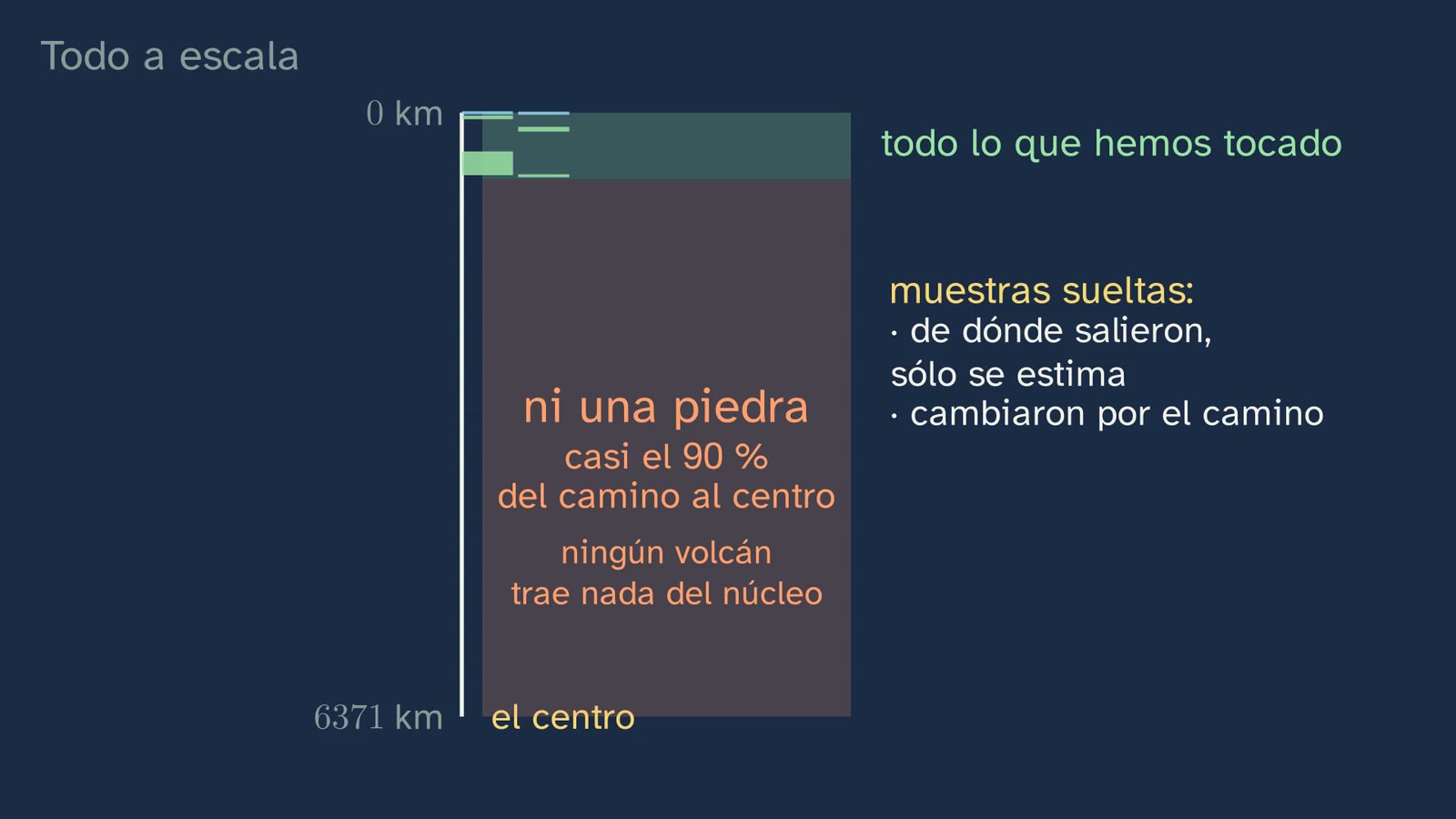
A cross-section of the Earth to scale, with successive zooms, shows that all of this fits into the top strip: for 90% of the way to the centre we do not have a single stone.
Then the indirect methods, one by one, each with its instrument and its example: - gravimetry: a gravimeter is, in essence, a weight hanging from a spring, and the board moves one across dense and light rocks while it draws the gravity curve; this is how ore deposits are found without drilling; - magnetism: Halley's compass, which in London swung 17° in a century, shows, together with the Curie temperature of magnetite (about 580 °C), that the field does not come from a magnet made of rock but from something that moves: molten iron in the core; - geothermal: the geothermal gradient, and the straight line extended to the centre, which gives 160,000 °C, about thirty times the estimate. What it does tell us: the Earth is hot and loses heat, and since the line cannot continue, further down heat must travel differently: the mantle, though solid, flows very slowly and carries it (there the temperature rises by less than 1 °C per kilometre). Class 5 deals with this; - seismic, which is announced for classes 3 and 4; - and iron meteorites, which can be touched but are not part of the Earth, with the Widmanstätten pattern and the assumption behind them: that the Earth and those asteroids were made from the same materials, rock and metal (this would not hold for Jupiter or Saturn, which are mostly hydrogen and helium).
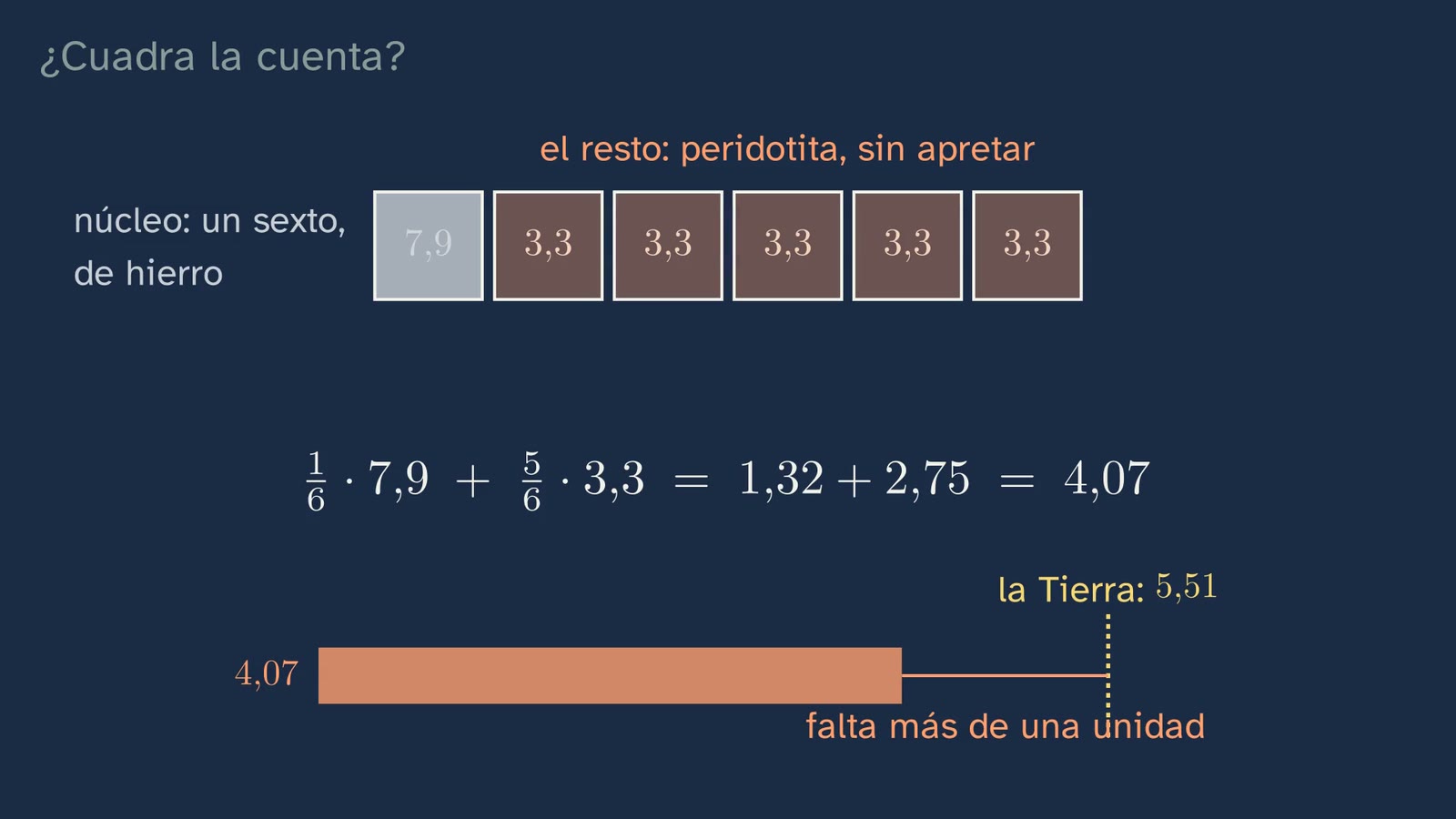
The meteorite "stop and think" leads to how a planet separates into layers. And the calculation (the problem before the explanation) shows that one sixth iron and five sixths rock give 4.07, not 5.5. What is missing is pressure, which squeezes both layers. The misconception that "indirect methods are guesses" is taken apart, and the final review gives the methods with their textbook names and the depth each one sees.
Objective. By the end, students will be able to tell direct methods from indirect ones, say how far each one reaches, and explain with several independent lines of evidence why the Earth has a dense, metallic centre, and why iron alone is not enough: pressure counts too.
What this sheet adds: - a table of the methods, with what each one measures and what depth it sees; - what the class leaves out, and why; - the typical mistakes, both those documented in research and those repeated in class notes and videos; - the solutions to everything; - a classroom activity, "The Earth in a corridor", with its worksheet.
For readers outside Spain: the Bachillerato is the last two years of secondary school (ages 16–18), and ESO is the compulsory stage before it (ages 12–16). The video is in Spanish, with English subtitles; the images on this sheet come from the video and keep their Spanish text. In Spain the decimal separator is a comma (5,5 g/cm³ means 5.5 g/cm³); this English sheet uses points.
Curriculum
Spain's Royal Decree 243/2022, Biology, Geology and Environmental Sciences (consolidated text in the Official State Gazette, BOE, checked on 03/10/2026; its latest update, of 02/07/2026, only affects article 23.4). Our translation of the official Spanish text. The minutes are those of the video.
| Element | What the decree says | Where the class works on it |
|---|---|---|
| Core knowledge (block D) | "Structure, composition and dynamics of the geosphere. Direct and indirect methods of study." | The whole class: the direct methods (2:50 to 8:18) and the indirect ones (8:18 to 14:55) |
| Core knowledge (block C) | "The history of the Earth: main geological events." | Only one, the one that explains the structure: how the Earth separated into layers (12:30). The formation of the planet, with its dates, belongs to topic 9 |
| Core knowledge (block A) | "The historical evolution of scientific knowledge: science as a collective, interdisciplinary endeavour in continuous construction." | Kola and the basalt layer that wasn't there: a corrected interpretation (2:50) |
| Specific competence 1 | "To interpret and communicate scientific information and data, arguing about them precisely and using different formats to analyse processes, methods, experiments or results of the biological, geological and environmental sciences." | The cross-section to scale and the graph of temperature against depth |
| Specific competence 3 | "To design, plan and carry out research projects following the steps of scientific methodologies…" Its description asks students to "understand in depth the difference between an impression or opinion and evidence". | The typical mistake: an indirect method is a measurement, not a guess (18:06) |
| Specific competence 4 | "To seek and use strategies to solve problems, critically analysing the solutions and answers found and reformulating the procedure if necessary…" | The core calculation (14:55) and the temperature line |
| Criterion 1.1 | "To critically analyse concepts and processes related to the subject's knowledge, interpreting information in different formats (models, graphs, tables, diagrams, formulas, schemes...)." | The cross-section to scale; the graph of the extended gradient |
| Criterion 1.3 | "To argue about aspects related to the subject's knowledge, defending a position in a reasoned way and with an open, flexible, receptive and respectful attitude towards the opinions of others." | The open question: is a sample you can touch worth more than many indirect measurements that agree? |
| Criterion 2.3 | "To argue about the contribution of science to society and the work of the people devoted to it… understanding research as a collective and interdisciplinary endeavour in constant evolution and influenced by the political context and economic resources." | Kola, at the height of the Cold War. To go further, this sheet's note on Kola: drilling stopped in 1992, because of the heat and the end of the Soviet Union |
| Criterion 3.1 | "To ask questions, make predictions and formulate hypotheses that can be answered or tested using scientific methods…" | The two predictions: the temperature at the centre and the calculation |
| Criterion 4.1 | "To solve problems or explain biological, geological or environmental processes, using varied resources such as one's own knowledge, data and information gathered, logical reasoning, computational thinking or digital tools." | The weighted mean of the core and the mantle |
| Criterion 4.2 | "To critically analyse the solution to a problem… and modify the procedures used or the conclusions reached if that solution is not viable or in the light of new data…" | Iron alone is not enough; the line cannot be extended to the centre; the basalt layer that wasn't there |
What students bring: - from class 1, that the Earth is twice as dense as its rocks, and what density is; - from lower secondary (ESO), the layers of the Earth.
In Spain's national minimum curriculum, the methods for studying the interior are taught in fourth-year ESO Biology and Geology, which is an elective, so some students arrive without having seen them. In Castile and León, ESO already teaches both models of the layers.
How the class is built
Video chapters
About twenty minutes, in eleven chapters. It is a theory class: Nil appears at the teacher's desk in the classroom.
| Chapter | What happens | Why this way |
|---|---|---|
| What we'll see (0:00) | The map of the topic: the second of five classes. | Knowing where you are. |
| A question from the previous class (0:24) | The puzzle: 5.5 against 2.7. | Recall before moving on. |
| Solutions to the previous class (0:58) | All three, briefly, with the density line and the grid of 1,600 squares. | Close what was pending without dragging it out. |
| Pieces of the mantle (2:08) | Nil: in Girona there are pieces of the mantle, and nobody went down to fetch them. How magma tears them off and why they don't sink. | A real hook close to home, and a reason why. |
| What we have touched (2:50) | Direct and indirect, defined. Drill cores; Kola: the heat and the basalt layer that wasn't there; the deepest mine. | Each direct method, with what it gives and how far it reaches; and an interpretation corrected by a sample. |
| Rock that rises on its own (4:43) | Xenoliths (the photo is from Lanzarote) and the pressure gauge in their minerals; Ronda, an outcrop of mantle; diamonds and their inclusions; and everything to scale, with successive zooms. | What no textbook offers: Spain in the samples, and the scale that shows how much is missing. |
| What we know without touching it (8:18) | The X-ray as a comparison; the gravimeter, a weight hanging from a spring, and gravity point by point; Halley's compass and the dynamo; the gradient, the extended line and what heat does tell us; seismic waves, announced. | Each indirect method, with its instrument, its example and its reason why. |
| Stones that fall from the sky (12:30) | Iron meteorites and the Widmanstätten pattern; the stop and think; how a planet separates into layers, and the assumption of the same materials. | The clue class 1 left, solved by reasoning. |
| Does the sum work? (14:55) | Six boxes: one sixth iron, five sixths rock. The result is 4.07. Pressure squeezes both layers and the result is 5.5; the calculation is not one more proof, but shows that the explanation is possible. Three independent paths, one iron centre. | The problem before the explanation, and honesty about what proves what. |
| Are they just guesses? (18:06) | The typical mistake, taken apart: an indirect method is a measurement; what can fail is the interpretation. And direct methods have their pitfalls too. | The mistake, out in the open. |
| Practice and keep thinking (18:59) | The review, with the textbook names and the depth each method sees; three exercises and the open question. | Spaced practice: the solutions open class 3. |
The methods at a glance
This is the table teachers expect to find, with the depth each method "sees", which is not usually in textbooks. "Direct" means that a piece of the Earth's own interior is studied; "indirect", that something is measured and what lies inside is deduced from it.
| Method | Type | What it measures or gives | How far it reaches | In the class |
|---|---|---|---|---|
| Boreholes and mines | Direct | Drill cores: cylinders of rock | Kola, 12 km; the deepest mine, about 4 km | Kola and Mponeng |
| Xenoliths | Direct | Pieces of mantle torn off by magma | The Spanish ones, about 30–60 km; those from kimberlites, 150–200 km | Lanzarote, Garrotxa, Calatrava |
| Mantle outcrops | Direct | Mantle raised by the plates | The Ronda peridotites come from about 60–70 km | Ronda |
| Inclusions in diamonds | Direct | Minerals trapped as the diamond grew | Almost all, 150–200 km; the deepest, just over 660 km | Juína (ringwoodite) and Cullinan |
| Mean density | Indirect | The Earth's mass and volume | The whole planet | Class 1 |
| Gravimetric | Indirect | Gravity point by point (gravimeter) | Mainly the crust and the upper layers | Ore deposits without drilling |
| Magnetic | Indirect | The magnetic field and how it changes | Its source, the core; the crust contributes a small part | Halley's compass |
| Geothermal | Indirect | Temperature in boreholes and mines, and the heat flowing out | The upper layers | The gradient at Kola and in the continents |
| Seismic | Indirect | How and when earthquake waves arrive | The whole planet | Classes 3 and 4 |
| Meteorites | Indirect | Pieces of other bodies: they can be touched, but they are not from the Earth | By comparison, the core (iron meteorites) | Muonionalusta, Hoba |
What about the electrical method? Three Spanish resources present it as if it looked into the interior of the planet. It measures the electrical resistance of the ground and is useful for the first few kilometres at most: groundwater, ore deposits. That is why it is not in the class.
A plan for a 50-minute lesson
| Minutes | What to do |
|---|---|
| 0–5 | No video: the solutions to class 1 on the board, and a question: what is the deepest point of the Earth's interior you think we have touched? Everyone writes down a figure. |
| 5–17 | Video up to "What we know without touching it" (8:18): the direct methods and the scale. Did they get their figure right? |
| 17–32 | The activity, "The Earth in a corridor" (first part), with the marks on this sheet. |
| 32–42 | Video from 8:18 to 18:06: the indirect methods, meteorites and the calculation. Do the calculation on paper before seeing it solved. |
| 42–50 | Pooling ideas with the table "The methods at a glance": complete it together. The rest of the video and the exercises, for homework. |
Notes for teachers
Kola, told properly. - The Soviet Union began drilling in 1970 and reached 12,262 m: the deepest hole ever drilled vertically. There are longer oil wells, but they are inclined or horizontal. Sources give 1989 or 1990 for the record. - At about 10 km the rock was at about 180 °C, almost twice what was expected (the USGS report gives 181–185 °C at 10,909 m), and at around 12 km, about 212 °C. - Seismic waves showed a change at around 7 km, which was interpreted as the transition from granite to basalt: the Conrad discontinuity, which Victor Conrad cautiously proposed in 1925. The borehole did not find it: there were fractured, water-saturated Archaean gneisses. - Note: in its first 6.8 km it did go through altered basalts, of the Pechenga series. What was not there was the deep basaltic layer. - Drilling stopped in 1992: the heat softened the rock, and with the end of the Soviet Union the money ran out. It is a good example for criterion 2.3. - The Cold War race was to drill deeper. Reaching the mantle was the goal of the American Mohole project, cancelled in 1966 because of its costs. - The "well to hell" is a hoax from 1989: the channel does not tell it, not even to debunk it.
The water in the ringwoodite. The ringwoodite grain in the Juína diamond (Pearson et al., 2014) contained about 1.5% water by weight. The paper concludes that this part of the mantle contains water "at least locally", at around 1%. Do not talk about "oceans beneath our feet": that is the headline of a press release, not the paper's conclusion.
Ronda. About 300 km² in the Ronda massif, and about 450 including those of Ojén and Carratraca. According to several authors, it is the largest known outcrop of subcontinental mantle; without "subcontinental", the Oman ophiolite is much larger. It entered the crust about 20–25 million years ago, and exactly how is still debated. Topic 2 returns to it.
The calculation, honestly. The mean densities of the core (11) and of the mantle and crust (4.45) come from the PREM model (Dziewonski and Anderson, 1981), which was fitted to seismic waves, to the Earth's mass and to its rotation. That is why the calculation gives 5.5 by construction: it proves nothing new, but shows that the explanation of iron plus pressure is possible. The class says so. The three independent paths are the Earth's weight, meteorites and magnetism.
The core is not pure iron. At that pressure, pure iron would be somewhat denser than the core: the outer core is between 5 and 10% lighter. That is why it is thought to contain, besides nickel, lighter elements (sulfur, silicon, oxygen…); which ones and how much is debated. Class 5 deals with this.
The Himalayan plumb line, which teachers may miss here, is in class 5, together with the isostasy it explains.
Why the gradient drops. Near the surface, heat escapes by conduction through rigid rock and the temperature rises quickly: on average, 25–30 °C per kilometre in the continents. In the mantle, which is solid but flows very slowly, heat is carried by the movement (convection), and there the temperature rises by less than 1 °C per kilometre. Class 5 deals with this; the origin of the heat, topic 2.
Typical mistakes and how they are handled
- "Indirect methods are guesses; the only sure thing is what you can touch." It is not documented as a student idea, but seven of twenty Spanish class notes and resources reviewed teach it in writing. An indirect method is a measurement, repeatable with instruments. What can fail is the interpretation, and that is why several are cross-checked: at Kola, a sample corrected what had been deduced from the waves. And direct methods have their pitfalls too: a loose sample may have changed on the way up, and we do not know exactly where it came from.
- "What comes out of volcanoes tells us what the core is like." Granda Vera (1988) asked students in the third year of BUP (ages 16 and 17) at a secondary school in Antequera what evidence would show what the core is like: 69% gave the materials from volcanoes, 12% seismic waves and 3% drilling (the question itself took for granted a "semi-fluid and incandescent" core). Ejarque, Bravo and Mazas (2016) found the same in almost half of 53 third-year ESO students in Zaragoza. The scale takes it apart: magma forms at tens or a few hundred kilometres, and no volcano brings up anything from the core.
- "The mantle is liquid; magma is the mantle." Magma forms when a small part of the mantle melts; the mantle is solid, although it flows over millions of years. Class 5 deals with it in depth.
- "A meteorite can be touched, so it is a direct method." It can be touched, but it is not a piece of the Earth: that is why it counts as indirect. The class says so.
- "Each type of meteorite is a piece of one of the Earth's layers." Five of twenty resources imply this. Iron meteorites are, for the most part, pieces of the cores of asteroids that separated into layers like the Earth. By comparison they tell us what the Earth's core is probably made of, but they are not from the Earth.
- "The magnetic field is produced by friction between layers" or "by gravity". Granda Vera (1988): 17% gave friction and 48% did not know; Dahl, Anderson and Libarkin (2005), with practising and trainee teachers, found that the most chosen cause was gravity. The class gives the evidence that it comes from something that moves (Halley's compass) and the mechanism, like a dynamo.
- Extending a trend beyond the data. At 25 °C per kilometre, the centre would be at about 160,000 °C, about thirty times more than the estimate.
- Kola figures given wrongly. "13 km", "15 or 20 km", "in Siberia" or "230 °C" all circulate. The borehole is on the Kola Peninsula, in north-west Russia, and the correct figures are in the note on Kola.
Questions and solutions
Stop and think (in the video)
- What was the Earth's mean density, and what is that of the rocks we walk on? The Earth, 5.5 g/cm³; a granite, about 2.7; a basalt, at most 3.3.
- If the temperature kept rising by 25 °C per kilometre all the way to the centre, how hot would it be there? 6,371 × 25 = 159,275: about 160,000 °C. The centre is estimated to be between 5,000 and 6,000 °C, about thirty times less (159,275 / 5,500 ≈ 29). The temperature does not keep rising at the same rate.
- Why does a piece of iron from space tell us something about the centre of the Earth? Because many asteroids melted and separated into layers, like the Earth: the iron, denser, sank and formed a core. Later they collided and broke apart. Most iron meteorites are pieces of those cores: they tell us what the Earth's core is probably made of.
- With an iron core (7.9) taking up one sixth of the volume and the rest unsqueezed rock (3.3), do we get 5.5? 7.9/6 + 5 × 3.3/6 = 1.32 + 2.75 = 4.07. It falls short. If the mantle stayed at 3.3, the core would need (5.5 − 2.75) × 6 = 16.5: more than the most compressed iron at the centre (about 13). Pressure squeezes both layers. With the mean densities of the PREM model, 11/6 + 5 × 4.45/6 = 1.83 + 3.71 ≈ 5.5.
Practice (the solutions open class 3)
- Classify as direct or indirect: a borehole, a xenolith, a gravimeter, a compass, a seismograph and a diamond with inclusions.
- Direct: the borehole (its drill cores), the xenolith and the diamond with inclusions, because they are pieces of the interior.
- Indirect: the gravimeter, the compass and the seismograph, because they measure something and what the interior is like is deduced from it.
- If the core takes up one sixth of the volume, its mean density is 11 and the Earth's is 5.5, what fraction of the mass is in the core? Mass is density times volume. The core's, in proportion, is 11 × 1/6; the Earth's, 5.5 × 1. The core's share is (11/6) / 5.5 = 1/3: one third. With the full PREM model, 32.5%.
- What is good and what is bad about a xenolith as a sample of the mantle?
- Good: it is real mantle, which can be touched, cut and analysed, and its minerals tell us what depth it comes from.
- Bad: it is a loose sample; its depth is estimated; it changed on the way up as it cooled and decompressed, and sometimes reacted with the magma; and it only reaches tens or a few hundred kilometres.
Keep thinking. Is a sample you can touch worth more than many indirect measurements that agree? It has no textbook answer. It is good for discussing three things: - what it means to "see" something: a sample also has to be interpreted; - why the agreement of independent paths gives confidence; - and when a single sample can overturn an interpretation, as at Kola.
It helps to ask each position to give an example from the class (criterion 1.3).
A classroom activity
The Earth in a corridor (about 15 minutes for the first part and 10 for the second; in groups of three or four).
Materials: a tape measure at least 7 m long (or a 7 m roll of paper), coloured tape and markers. To scale, one metre is a thousand kilometres: the Earth's radius measures 6.37 m.
- Prediction (criterion 3.1). Before measuring, each group sticks a mark where they think the deepest point we have touched lies.
- The marks. From the "ground" (the 0 on the tape), in centimetres:
| What | Real depth | In the corridor |
|---|---|---|
| The deepest mine | about 4 km | 0.4 cm |
| The Kola borehole | 12.3 km | 1.2 cm |
| The Spanish xenoliths | about 30–60 km | 3–6 cm |
| Xenoliths and diamonds from kimberlites | 150–200 km | 15–20 cm |
| The ringwoodite in the Juína diamond | 410–660 km | 41–66 cm |
| The deepest inclusion | just over 660 km | just over 66 cm |
| The edge of the core (PREM) | 2,891 km | 2.89 m |
| The edge of the inner core (PREM) | 5,150 km | 5.15 m |
| The centre | 6,371 km | 6.37 m |
- The question. What part of the corridor has no sample at all? (From 0.66 m to 6.37 m: almost 90%.) Was their prediction right? Which methods tell us something about that stretch?
- Second part: the calculation with boxes (criterion 4.1). On paper, six equal boxes: one of iron (7.9) and five of rock (3.3). Work out the mean and compare it with 5.5. Then try 11 and 4.45 (the means of the PREM model). Discuss why the second is not new evidence: those numbers were fitted to the Earth's weight.
Sources
- Royal Decree 243/2022, consolidated text (BOE): https://www.boe.es/buscar/act.php?id=BOE-A-2022-5521. Lower secondary (ESO): Royal Decree 217/2022 (BOE): https://www.boe.es/buscar/act.php?id=BOE-A-2022-4975.
- Kola: EarthDate (University of Texas), https://www.earthdate.org/episodes/kola-superdeep; USGS, summary of Kozlovsky's book (1984), https://pubs.usgs.gov/of/1986/0517/report.pdf; Lobanov et al. (2021), Arktika i Sever 44, doi:10.37482/issn2221-2698.2021.44.267. The Mohole project: National Academy of Sciences, https://www.nasonline.org/about-nas/history/archives/milestones-in-NAS-history/project-mohole.html.
- The deepest mine (Guinness World Records): https://www.guinnessworldrecords.com/world-records/66169-deepest-mine.
- Xenoliths: Garrotxa (UAB Divulga, 2011), https://www.uab.cat/web/detalle-noticia-1345680342040.html?articleId=1304922551263; Lanzarote (Geopark), https://geoparquelanzarote.org/en/geositio/lz37-los-hervideros-2/, and Grachev (2012), doi:10.2205/2012ES000515; Campo de Calatrava (Complutense University of Madrid), https://docta.ucm.es/rest/api/core/bitstreams/5f08b974-1e29-4341-8ba5-37fcdfac8a42/content. The rapid ascent: Sparks et al. (2006), doi:10.1016/j.jvolgeores.2006.02.010.
- Ronda and the Sierra de las Nieves: Geolodía Málaga 2019 (Geological Society of Spain), https://cehiuma.uma.es/wp-content/uploads/Geologuia_Malaga_2019.pdf.
- Diamonds: GIA (2018), https://www.gia.edu/gems-gemology/winter-2018-how-do-diamonds-form-in-the-deep-earth; Pearson et al. (2014), Nature 507, 221, doi:10.1038/nature13080; Nestola et al. (2018), Nature 555, 237, doi:10.1038/nature25972.
- Gravimetry: the gravimeter, a weight hanging from a spring (University of British Columbia, Geophysics for Practicing Geoscientists, CC BY 4.0), https://gpg.geosci.xyz/content/gravity/gravity_basics.html; ESA, GOCE, https://earth.esa.int/eogateway/documents/20142/37627/GOCE-ESAs-Gravity-Mission.pdf; USGS OFR 95-831, https://pubs.usgs.gov/of/1995/ofr-95-0831/CHAP3.pdf.
- Magnetism: British Geological Survey, https://geomag.bgs.ac.uk/education/earthmag.html; Halley (1692), Phil. Trans. 16, 563, https://zenodo.org/record/1432132; the Curie temperature (Britannica), https://www.britannica.com/science/Curie-point.
- Heat: IPCC (2011), ch. 4, p. 406; Earle, Physical Geology, ch. 9.2 (CC BY 4.0), https://geo.libretexts.org/Bookshelves/Geology/Physical_Geology_(Earle)/09%3A_Earths_Interior/9.02%3A_The_Temperature_of_Earths_Interior; Anzellini et al. (2013), Science 340, 464.
- Meteorites: Natural History Museum, London, https://www.nhm.ac.uk/discover/types-of-meteorites.html; PSRD (2007), http://www.psrd.hawaii.edu/April07/irons.html; Korotev (Washington University), https://sites.wustl.edu/meteoritesite/?p=230. Jupiter and Saturn, mostly hydrogen and helium (NASA): https://science.nasa.gov/jupiter/jupiter-facts/ and https://science.nasa.gov/saturn/facts/.
- Separation into layers: Earle, Physical Geology, ch. 22.4 (CC BY 4.0); Kleine and Rudge (2011), Elements 7, 41.
- The PREM model: Dziewonski and Anderson (1981), doi:10.1016/0031-9201(81)90046-7; EarthScope, https://data.earthscope.org/app/products/portal/emc_model_viewer.html?id=EMC-PREM. The core is not pure iron: Hirose, Wood and Vočadlo (2021), Nature Reviews Earth & Environment 2, 645.
- Students' ideas: Granda Vera, A. (1988), Esquemas conceptuales previos de los alumnos en Geología, Enseñanza de las Ciencias 6(3), 239–243, doi:10.5565/rev/ensciencias.5100; McAllister (2014), https://files.eric.ed.gov/fulltext/EJ1101087.pdf.
About this class
GinCol Lab is a free science channel for curious minds. Nil is an illustrated character, not a real person, with a synthetic voice: computer-generated with Microsoft Azure AI Speech, and not imitating any known person. The board is animated with Manim. The script and this sheet are written by an AI (Claude, by Anthropic) and reviewed by a person before publishing. Every fact is checked in two sources or in the original, and every calculation by running it. This English version was translated by the same AI. The photos of the rocks, the diamond, the meteorites and the drill core are real, with their author and licence on screen. The borehole, the magma, the gravimeter and the planet separating into layers are drawn. If you spot a mistake, tell us: learning also means correcting.
This sheet is published under a Creative Commons Attribution 4.0 licence: you can copy it, adapt it and use it in your classroom, crediting GinCol Lab. The photos that appear in the board images keep their authors and licences, which are written on the image itself.
How to cite this sheet
GinCol Lab (2026). What we have touched and what we haven't. GinCol Lab teacher sheet: Biology, Geology and Environmental Sciences · 1st year of Bachillerato · Inside the Earth · Class 2 of 5. https://gincollab.github.io/aula/en/biologia-geologia-ccaa/t01-c2/. CC BY 4.0.
GinCol Lab teacher sheet · CC BY 4.0 · Source and errata